Dhtml Menu Behind The Frame by Deluxe-Menu.com
Dhtml Menu Behind The Frame

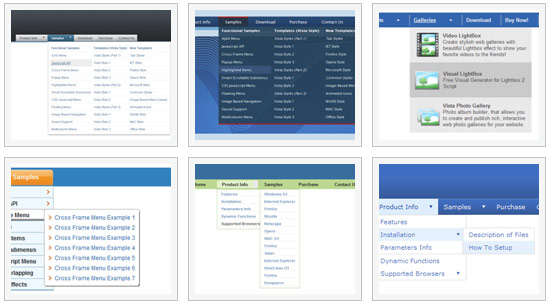
Menu Screenshots

Dhtml Menu Behind The Frame Creating Html Menus

Features

Unrivalled Features
  • Scrollable, dragable, floating, right-click menus
  • Keyboard navigation - press Ctrl+F2 to enter the menu
  • Unique Java Script API for altering menu "on-the-fly", without page reloading
  • AJAX technology - loads menu data from the server "on-fly and on-demand".
  • Search feature - add the search area in the menu and type symbols. The found words will be higlighted.
  • Sound support!
Easy Setup
  • De Luxe Tuner. GUI interface to create your dhtml menu behind the frame menus easily and in no time
  • Sensible menu parameters for manual editing
Javascript Drop Down Menus Dhtml Menu Behind The Frame
Cost Effective
Compatibility              
  • Full cross-browser compatibility including IE, Netscape, Mozilla, Opera, Firefox, Konqueror and Safari on Windows, Mac OS and Linux
  • Menu can be populated from a database using ASP, PHP, etc.
  • Search engine friendly
  • Support for any doctypes
  • Fits for secure sites
  • Section 508 compliant
Professional Look-n-feel
  • Entirely customizable look-n-feel
  • A lot of pre-designed dhtml menu behind the frame samples
  • Hundreds of visual effects
  • Custom CSS styles can be applied for all menu settings


2.0 Buttons by Web-Buttons.com v3.0.0

Javascript Menu. DHTML Menu.

  • Tune menu parameters manually or using Deluxe Tuner. Then add several rows of a code within html page - your menu is ready!
  • Use special JavaScript functions for: Dynamic changing of items (text, link, icons and even individual style!). Making a menu item active/inactive. Addition/removing of items. Changing of visibility of items. Getting the information on any menu, submenu and items. Other tricks.
  • Opportunity to control the menu from the keyboard.
  • Cross-frame mode allows you to build full-featured menus on the pages that use frame-based structure. But for all that it's not necessary to insert any additional code into all the pages - just specify some additional parameters of the menu.

Recent Questions

Q: The xml drop down menu gets at the back of the flash..Can you tell us the problem?

A: You can try to add the following parameters for flash objects:

<PARAM NAME=wmode VALUE=opaque> and WMODE="opaque" for <EMBED>

It allows to overlap a flash movie by other layers.

For example:
<OBJECT classid="clsid:D27CDB6E-AE6D-11cf-96B8-444553540000"
codebase="http://download.macromedia.com/pub/shockwave/cabs/flash/swflash.cab#version=6,0,0,0" WIDTH="120" HEIGHT="40">
<PARAM NAME=movie VALUE="data-samples/flash-deluxe-menu.swf">
<PARAM NAME=quality VALUE=best>
<PARAM NAME=bgcolor VALUE=#FFFFFF>
lt;param name="wmode" value="opaque">
<EMBED src="data-samples/flash-deluxe-menu.swf" quality=best wmode="opaque" bgcolor=#FFFFFF WIDTH="120" HEIGHT="40"NAME="data-samples/flash-deluxe-menu" TYPE="application/x-shockwave-flash" PLUGINSPAGE="http://www.macromedia.com/go/getflashplayer">
</EMBED>
</OBJECT>

Q: I am looking for a way to use "position:fixed; in order to keep my drop menu navigation at the top of the screen when scrolling down.

Can you tell me how to do this?

A: You should use floating feature to keep your drop menu navigation at the top of thescreen when scrolling down.

See more info here:
http://www.deluxe-menu.com/floatable-menu-sample.html



Q: Last, I couldn't solve the issue I meet when I set up a long name for an dhtml side menu item: next item overlaps. Is it possible to specify the width of an item?

A: You can try to use the following dhtml side menu parameters to use combinedbackground for your items:

  var beforeItemImage = [,]; //left-side image for normal and mouse over state
  var itemBackImage = [,]; //background or image for normal and mouse over state
  var afterItemImage = [,]; //right-side image for normal and mouse over state
  var beforeItemImageW = '';
  var afterItemImageW = '';
  var beforeItemImageH = '';
  var afterItemImageH ='';

But you should create a small images in any Graph Editor, for example:
button_n_back.gif
button_n_left.gif
button_n_right.gif
button_o_back.gif
button_o_left.gif
button_o_right.gif


Q: I'm having a difficult time figuring out how to get content into each "tab" for the dhtml tab menus.
I see that content can be put into div-tag or frame, but how is it referenced in tab so whensomeone clicks the tab,
it shows that content?
Is it the link variable in the MenuTuner? Can the content be a separate html page?

A: See in Deluxe Tabs there are two modes:

1.   var tabMode=0;
You can create only one level of tabs and assign Object Id's of the
DIV's to show when you click on the tab.

["XP Tab 1","content1", "", "", "", "", "", "", "", ],
["XP Tab 2","content2", "", "", "", "", "", "", "", ],
["XP Tab 3","content3", "", "", "", "", "", "", "", ],
["XP Tab 4","content4", "", "", "", "", "", "", "", ],

2.   var tabMode=1;
You can assign only links in this mode.
You should create top level items with subitems.

["XP Tab 1","", "", "", "", "", "", "", "", ],
 ["|Link 1_1","http://deluxe-tabs.com", "", "", "", "", "0", "", "", ],
 ["|Link 1_2","testlink.htm", "", "", "", "", "0", "", "", ],
 ["|Link 1_3","testlink.htm", "", "", "", "", "0", "", "", ],
 ["|Link 1_4","testlink.htm", "", "", "", "", "0", "", "", ],
 ["|Link 1_5","testlink.htm", "", "", "", "", "0", "", "", ],
["XP Tab 2","", "", "", "", "", "", "", "", ],
 ["|Link 2_1","testlink.htm", "", "", "", "", "0", "", "", ],
 ["|Link 2_2","testlink.htm", "", "", "", "", "0", "", "", ],
 ["|Link 2_3","testlink.htm", "", "", "", "", "0", "", "", ],
 ["|Link 2_4","testlink.htm", "", "", "", "", "0", "", "", ],
 ["|Link 2_5","testlink.htm", "", "", "", "", "0", "", "", ],
["XP Tab 3","", "", "", "", "", "", "", "", ],
 ["|Link 3_1","testlink.htm", "", "", "", "", "0", "", "", ],
 ["|Link 3_2","testlink.htm", "", "", "", "", "0", "", "", ],
 ["|Link 3_3","testlink.htm", "", "", "", "", "0", "", "", ],
 ["|Link 3_4","testlink.htm", "", "", "", "", "0", "", "", ],
 ["|Link 3_5","testlink.htm", "", "", "", "", "0", "", "", ],

You can use Object ID as well as Link in both modes. Use the following prefixes within item's link field:
"object:" - means that there is object id after it;
"link:" - means that there is a link after it.
"javascript:" - means that there is a javascript code after it, for example:javascript:alert(\'Hello!\')

So, you should write for example:

 ["|Link 1_1","object:Content1_1", "", "", "", "", "0", "", "", ],