Recent Questions
Q: I want to know how I can set a menu item to pressed
when a page is loaded in javascript drop down menus.
A: You should set a pressed item using Javascript API:
function dm_ext_setPressedItem (menuInd, submenuInd, itemInd, recursion)
Sets a current pressed item.
menuInd - index of a menu on a page, >= 0.
submenuInd - index of a submenu, >= 0.
itemInd - index of an item, >=0.
recursion = true/false - highlight parent items.
Q: Hi, I need to know if it is possible to accomplish the following functionalities with your tree-menu library.
1. I need to have two or more trees in the same page
2. I need to have a checkBox in each node and through a JavaScript function be able to add the selected nodes into another tree.
3. I need to eliminate the nodes that has check=true
4. I need to populate on-demand the tree using AJAX
5. I need to implement drag&drop through the use of the mouse events on the tree nodes
6. How would the tree behave with 10000 nodes??
7. I need to have a tree within another element that uses scroll
such as a DIV or SPAN (fixed area). When collapsed or expanded, the area should remain its original size.
A: 1. You can add any number of the menus on the one page.
2, 3, 5. Yes, you can do it. But you should create your own server-side script (for example, php) that will do it. The menu doesn't support such a feature.
4. Unfortunately, you can't use the AJAX-like technology in the Deluxe Tree such as in Deluxe Menu.
6. It is possible that the loading speed can be lower if the menu is very large. But it doesn't take so much time.
Yes, you can notice some delay in IE, but in over browsers it works better.
Deluxe Tree works fast, but 10000 is a large value. Please, try atrial version of Deluxe Tree.
I tried to create large menus on my machine: P4 3GHz, 512RAM WinXP SP2
It takes:
- 1000 items ~ 10 sec
- 2000 items ~ 40 sec
7. You can paste Deluxe Tree into the <table> or <div>.
Q: Is there a way to center floatable menus horizontally on a page?
I used to use absolutePos=0, and all of my menus were centered ok, but when I tried floatable=1 I found that I had to change toabsolutePos=1 to get the menu to float, and this messed up my centering. Since I have multiple menus of different widths, I'd rather not have to hard-code the menu width, but please let me know if there's a better way.
A: Notice, when you use floatable menu you can't use relative menu position.
So, if you use
var absolutePos = 0;
and to center the menu you use <p> or <div> with the center alignment your menu won't float.
To center your floatable menu you should set absolute coordinates.
Q: When i stay on one page so must have the menue-point of the html menu for this page another color or font. How can i make this?
A: You should set pressed item.
Please, check the following parameter
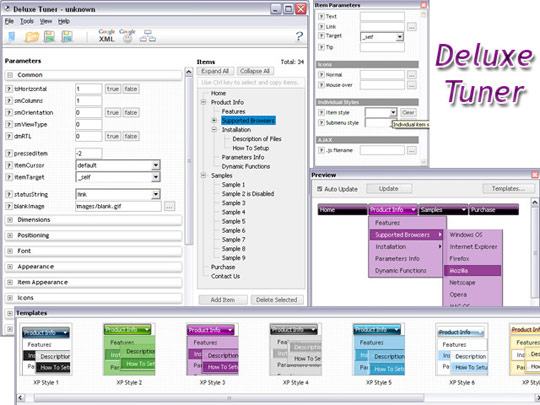
var pressedItem=-2;
This parameter sets an index of an item that will be highlighted by default.
-2 - the toggle mode is disabled;
-1 - the toggle mode is enabled, but no items highlighted by default;
0,1,2,3,... - index of highlighted item in a top-menu.
You can set a pressed item using Javascript API:
function dm_ext_setPressedItem (menuInd, submenuInd, itemInd, recursion)
Sets a current pressed item.
menuInd - index of a menu on a page, >= 0.
submenuInd - index of a submenu, >= 0.
itemInd - index of an item, >=0.
recursion = true/false - highlight parent items.
But notice, to use dm_ext_setPressedItem() you should know ID of selected item and subitem.
You can't get this ID after you reload your page. That is why you should write your own code on PHP.
You can also set the correct
var pressedItem=1;
parameter on each html page.