Flash Footer Menu by Deluxe-Menu.com
Flash Footer Menu

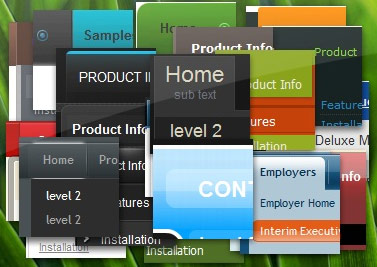
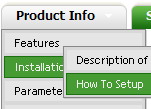
Menu Screenshots

Flash Footer Menu Navigation Scripts

Features

Cost Effective
Seamless Integration
  • Cross-frame support - menus work on frameset-based pages
  • Visible over flash, select boxes, iframes, java applets
  • Multiple menus on the same page
  • Amicable to other scripts and css styles
  • Any HTML code can be used inside menu items
Javascript Pulldown Menue Flash Footer Menu
High Performance
  • AJAX menu loading - loads web menu data from the server "on-the-fly".
  • Commonly loads quicker than other html page elements
  • UL/LI items structure
  • Runs well with an unlimited number of submenus and items
Compatibility              
  • Full cross-browser compatibility including IE, Netscape, Mozilla, Opera, Firefox, Konqueror and Safari on Windows, Mac OS and Linux
  • Menu can be populated from a database using ASP, PHP, etc.
  • Search engine friendly
  • Support for any doctypes
  • Fits for secure sites
  • Section 508 compliant
Easy Setup
  • De Luxe Tuner. GUI interface to create your flash footer menu menus easily and in no time
  • Sensible menu parameters for manual editing


2.0 Buttons by Web-Buttons.com v3.0.0

Javascript Menu. DHTML Menu.

  • There can be multi level menus - create as many rows or columns of the menu as you want.
  • Use a mouse to drag a menu as a usual window. Also you can construct the menu where each submenu can be "detached" from the main menu (MSOfficeToolbarLike mode).
  • When the page is scrolled the menu remains visible. The DHTML menu can "float" along one or two coordinate axes.

Recent Questions

Q: Couple last questions. I have 25 icons (images) on one page. Each image needs it's own popup menu. Obviously I now have the first one working. How and where do I define IDs number 2-24 ? Does each icon need it's own "source_" file?

Also, where is it defined that the popup menu is ID 1 ?


A: > Also, where is it defined that the popup menu is ID 1 ?
Each menu has ID. The ID's number starts with 0.

So, when you have several data files on your page you have such ID's:

<script type="text/javascript" language="JavaScript1.2" src="menu-top.js"></script> // ID - 0

<script type="text/javascript" language="JavaScript1.2" src="source_pop.js"></script> // ID - 1

<script type="text/javascript" language="JavaScript1.2" src="source_pop1.js"></script> // ID - 2

<script type="text/javascript" language="JavaScript1.2" src="source_pop2.js"></script> // ID - 3

<script type="text/javascript" language="JavaScript1.2" src="source_pop3.js"></script> // ID - 4

and so on.

> I have 25 icons (images) on one page. Each image needs it's own popup menu.
If you want to have different Popup menus (there color, item, text,font and so on) you should create 25 different .js files with yourparameters. And call them from your page, for example:

<SCRIPT language=JavaScript1.2 src="source_pop.js" type=text/javascript></SCRIPT>
<SCRIPT language=JavaScript1.2 src="source_pop1.js" type=text/javascript></SCRIPT>
<SCRIPT language=JavaScript1.2 src="source_pop2.js" type=text/javascript></SCRIPT>
...
<SCRIPT language=JavaScript1.2 src="source_pop24.js" type=text/javascript></SCRIPT>

If you have different item text only you can use one
<SCRIPT language=JavaScript1.2 src="source_pop.js" type=text/javascript></SCRIPT>
file. But you should delete the following code:

  var menuItems = [

["Next","testlink.htm"],
["Prev","testlink.htm"],
["Close","testlink.htm"],
];

dm_init();

and move it to the html page:

<body>
...
<SCRIPT language=JavaScript1.2 src="source_pop.js" type=text/javascript></SCRIPT>
<script type="text/javascript"> //first popup menu ID - 1
  var menuItems = [

["Next","testlink.htm"],
["Prev","testlink.htm"],
["Close","testlink.htm"],
];

dm_init();
</SCRIPT>
<script type="text/javascript"> //second popup menu ID - 2
  var menuItems = [

["Text","testlink.htm"],
["Text1","testlink.htm"],
["Text2","testlink.htm"],
];

dm_init();
</SCRIPT>
<script type="text/javascript"> //third popup menu ID - 3
  var menuItems = [

["New_Text","testlink.htm"],
["New_Text1","testlink.htm"],
["New_Text2","testlink.htm"],
];

dm_init();
</SCRIPT>
...
<script type="text/javascript"> //twenty fourth popup menu ID - 3
  var menuItems = [

["New","testlink.htm"],
["New","testlink.htm"],
["New","testlink.htm"],
];

dm_init();
</SCRIPT>

<img src="testimage.gif" width=200 onClick="return dm_popup(1, 1000, event);" style="cursor: hand;">
<img src="testimage.gif" width=200 onClick="return dm_popup(2, 1000, event);" style="cursor: hand;">
<img src="testimage.gif" width=200 onClick="return dm_popup(3, 1000, event);" style="cursor: hand;">
...
<img src="testimage.gif" width=200 onClick="return dm_popup(24, 1000, event);" style="cursor: hand;">
...
</body>


Q: What the options of CSS Submenu, CSS Item, and CSS Text each handle.
What are the differences in the application?


A:   var cssSubmenu is a CSS class name for all submenus. You can set, forexample, background color, background image, borders for all submenus.

  var cssItem is CSS class names for all items (normal state, mouseoverstate) in the top menu and submenus.

  var cssItemText is CSS class names for text of all items (normalstate, mouseover state) in the top menu and submenus.

It's possible to appoint individual CSS styles for separate elements of the menu using individual item styles and individual submenu styles.

I sent you an example with css. Please, see how you can use css in themenu.


Q: > You should call the following function:
> dtreet_ext_getItemIDByIndex (0, 12)
> where 12 - is index of the item.

How would I know that 12 is the index of the item? How is itemInd different from its itemID? I assume the menuInd is always 0 for the first menu (or only in my case) menu on a page?


A: Yes, menuInd is the number of the menu on your page (in your casemenuInd=0).

itemInd is the number of the item in your menuItems, for example:

  var tmenuItems =
[
["Home", "http://deluxe-tree.com", "icon1_t.gif", "icon1_to.gif","", "Home Page Tip","_blank"],//itemInd=0

["<img src='data_files/images/sep.gif' width=113 height=1>"],//itemInd=1

["+What's New<br><span id='letter'>This is pretty cool. I need to buy this deluxe menu</span>", "", "icon2_t.gif", "icon2_to.gif", "", "Product Info Tip"],//itemInd=2
 ["|What's New", "testlink.htm", ""], //itemInd=3
 ["|Features", "testlink.htm", ""], //itemInd=4
 ["|Installation", "testlink.htm", ""], //itemInd=5
 ["|Functions", "testlink.htm", ""], //itemInd=6
 ["|Supported Browsers", "testlink.htm", ""], //itemInd=7
["Samples", "", "icon3_t.gif", "icon3_to.gif", "", "Samples Tip"], //itemInd=8
 ["|Sample 1", "testlink.htm", ""], //itemInd=9
 ["|Sample 2", "testlink.htm", ""], //itemInd=10
 ["|Sample 3", "", ""], //itemInd=11
   ["||New Sample 1", "testlink.htm", ""],//itemInd=12
   ["||New Sample 2", "testlink.htm", ""],//itemInd=13


Q: Hi - I've turned on tsavestate which works, but it acts erratically. I have my javascript cascade menu .js file in a /js folder, and the site has multiple directories, but all the pages in all directories use the same menu SSI include, which uses the same deluxemenu code in the common /js folder. I read your KB article about states, cookies and multiple folders, but it is confusing... does it actually save state per directory, versus per the entire domain? I only have one menu for the entire site.. just would like it to save state correctly for all pages in all folders that include that javascript cascade menu.

A: It's a feature of the browser. It creates different cookies for eachsubdirectory.The only way is to place all your pages in the one directory.