Recent Questions
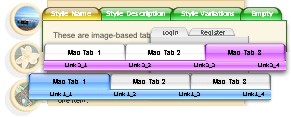
Q: I am interested in Deluxe Tabs MAC Style.
However before I do I want to make sure that:
- I can change the buttons pictures on both the first row and the second row. There has to be a <img src=" " > tag in the code somewhere, correct?
- I can expand or diminish the number of buttons and links
- Also, I have a question: if I am on "Mac Tab 1" menu, and I click on "Mac Tab 2" menu without clicking on any of the links onthe second row, what is the page that I see? Do I see by default Link 2_1 or do I see some kind of generic page? In other words is there a "main" page for each tab menu and then you have the other pages which correspond to Link 2_1, Link 2_2, etc.?
- Is it possible to remember a visited sub-menu? For example I am on "Mac Tab 2/Link 2_3" and I go to "Mac Tab 4/Link 4_2" and then I come back to "Mac Tab 2". Can the main page for this "Mac Tab 2" be Link 2_3 which was my last visited link on that tab?
A: 1) No, there is no such tag - <img src=" " >
For the main items you should set such parameters:
bbeforeItemImage - left part of the item
bafterItemImage - right part of the item
bitemBackImage - center part of the item
in normal, mouseover and selected states.
And for the subitems (in MAC template) you should set onlybitemBackImage - the center part of the item.
Please, see the code of this template.
2) You can create any number of the buttons and links.
3) You can set links for main items and for the subitems.
For example:
var bmenuItems =
[
["Mac Tab 1","http://deluxe-menu.com",,,,,,],
["|Link 1_1","http://apycom.com",,,,,,"0"],
["|Link 1_2","testlink.htm",,,,,,"0"],
["|Link 1_3","testlink.htm",,,,,,"0"],
So, if you click on "Mac Tab 1" you will go to http://deluxe-menu.com
And if you write so
["Mac Tab 1","",,,,,,],
no page will open.
4) This Tab menu can save pressed item automatically within1 page only. If you open another page, the menu can't remember presseditem. You should do that manually using Javascript and menu parameters( var bselectedItem, var bselectedSmItem) or using any server-sidescript (php, asp, etc.)
Q: How can make dhtml tabs to open internet link in the same window?
A: You should set the following paramter in your data.js file (file, created in Deluxe Tuner),
where your tab-menu parameters (vars) and items ( var bmenuItems) are placed.
var bitemTarget = "_blank";
Default target for all items ("_self","_blank","_parent","_top",...).
If equal to "" - defined as "_self".
Or you can set target parameter in your data file using Deluxe Tuner:
"Tab mode" section in the menu parameters list.
Q: I want that the font of an selected menupoint for the horizontal tree view is bold and red.
What is the variable to define that?
A: Try to use the following parameter:
var tpressedFontColor = "#AA0000";
// Color of a text of selected items. Used when var ttoggleMode = 1.
Date: 10.21.2005
Q: I am having some difficulty dynamically adding items to a tree javascript and menu.
I have a menu with one "root" item. I see the use of the "+" symbol within the item name. I do not see any documentation regarding this symbol, only "|". Can you explain?
If I have one menu with this one "root" node, how would I add an subitem to this root node?
Here is my code so far, but the inserted items appear to be at the same level as the root node.
var rootItem = dtreet_ext_getItemIDByIndex ( 0,0 );
var menuItem = new Array(10);
for ( var i = 0; i < producers.length; i++ )
{
var producer = producers[ i ];
menuItem[0] = producer.name;
dtreet_ext_insertItem ( 0, 0, i + 1, menuItem );
A: See dtreet_ext_insertItem () function has the following parameters:
function dtreet_ext_insertItem (menuInd, parentItemID, itemInd, itemParams)
Creates a new item and inserts it into a specified position.
menuInd - index of a javascript and menu on a page, >= 0.
parentItemID - ID property of an item.<, >= 0.
itemInd - index of a new item within the javascript and menu, >= 0.
itemParams - item parameters.
Notice that parentItemID is the Id property of the parent item (notindex). If you want to add top items you should set parentItemID=0.
itemInd - you should use this parameter if you want to add item in thespecific place, for example set itemInd=5 if you want to add itembefore the existing item with itemInd=5.
If you set itemInd=null the new item will be added at the end of this submenu and its index will be added automatically.