Recent Questions
Q: Why is it that when we place a drop menu ina div that the droppping part is not right uner the menu? The menu on top banner is the problem.. Thesame code outside of a div futher down the page works fine.
I can place the same menu outside of the div and it works fine.When it is in a div the drop part of the menu is pushed to the far right of the screen.
A: Brian, see, the problem is that the script can't get css properties of the object if they are described in separate .css block (or file).
In other words, you can't get the value of "POSITION: absolute" attribute of the object if the object doesn't have this property within inline style (style="POSITION:absolute;"). To get the value you should move .css style into style="" attribute.
Please, try to add your
css file -> inline css, for example:
You should add style="POSITION: absolute;"
to the
<div id="menu">
So, you'll have:
<DIV id="menu" style="POSITION: absolute;">
Q: Thanks for getting back with me but how do you build the menu?
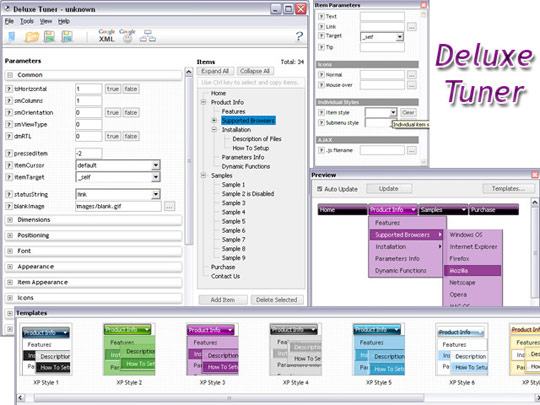
I opened Deluxe Tuner program to build a menu and there are categories titled common, dimensions, font, appearance etc. and I have NO IDEA what to do?
Can you walk me through the development of a menu?
A: First of all you should add items.
Please, click "Add item" and "Add subitem".
In the "Item parameters" window you can set text, link, target, iconsfor the menu items. You can also assign different style for each menuitem (item style and submenu style).
But at first you should create this style. Click "Edit IndividualStyle/Add Style" and set different parameters for the style.
Try to set different parameters of the menu.
In the "Preview window" you can see all your changes.
First of all you should choose menu orientation:
var isHorizontal = 1; Menu orientation: 0 - vertical, 1 - horizontal.
You can set exact width and height of the menu in the "Dimension"category.
You should set
var absolutePos=1;
if you want to have absolute positioning menu.
Font style you can set in the "Font" category.
To set color of the menu you should set the following parameters:
var menuBackColor="#FCEEB0";
var menuBorderColor="#C0AF62";
var itemBackColor=["#FCEEB0","#65BDDC"];
var itemBorderColor=["#FCEEB0","#4C99AB"];
Try also to change these parameters:
var itemSpacing=3;
var itemPadding="3px";
Arrows for main items and subitems you can set here:
var arrowImageMain=["default.files/arrowmain.gif","default.files/arrowmaino.gif"];
var arrowImageSub=["default.files/arrowsub.gif","default.files/arrowsubo.gif"];
If want to have floatable or movable menu you should set the followingparameters:
var floatable=0;
var movable=0;
You can also try to change any template.
Q: Can you tell me the difference between a target and a link.
Also can you explain what self, blank, top, parent, search and custom mean in the javascript menu table please.
A: Link is the url you want to open when you click on the javascript menu table item.
Target controls where you'll open your link:
"_self" - open link in the same window
"_blank" - open link in the new window
"_parent" - will load the linked document where the inner frameset file had been
"_top" - loads the linked document in the topmost frame
custom - you should write here the name of the frame where you want to
open the linked document, for example:
"framename"
"_search" - this target causes the link to load in the browser's Search pane. (Internet Explorer 5.0 and later.)
You can find more info here:
http://www.htmlcodetutorial.com/linking/_A_TARGET.html
Q: On the home page, when using Opera, and I have a report from a user who viewed the site with Safari, that the home page dhtml select menu did not work, but the subsequent pages did. I have no problem when using Internet Explorer, and I have not yet tested the site with Firefox. Do you have an idea what may be causing this behavior, and how to fix it?
A: Try to add the following style to your TD tag.
<TD id=navborder vAlign=top width=200 style="z-index: 10; position: relative;">