Javascript Slider Control by Deluxe-Menu.com
Javascript Slider Control

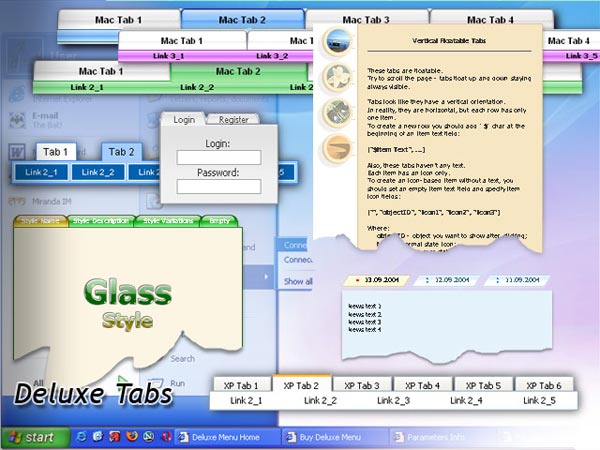
Menu Screenshots

Javascript Slider Control Side Menu Bars

Features

Easy Setup
  • De Luxe Tuner. GUI interface to create your javascript slider control menus easily and in no time
  • Sensible menu parameters for manual editing
Compatibility              
  • Full cross-browser compatibility including IE, Netscape, Mozilla, Opera, Firefox, Konqueror and Safari on Windows, Mac OS and Linux
  • Menu can be populated from a database using ASP, PHP, etc.
  • Search engine friendly
  • Support for any doctypes
  • Fits for secure sites
  • Section 508 compliant
Javascript Menu Samples Javascript Slider Control
High Performance
  • AJAX menu loading - loads web menu data from the server "on-the-fly".
  • Commonly loads quicker than other html page elements
  • UL/LI items structure
  • Runs well with an unlimited number of submenus and items
Unrivalled Features
  • Scrollable, dragable, floating, right-click menus
  • Keyboard navigation - press Ctrl+F2 to enter the menu
  • Unique Java Script API for altering menu "on-the-fly", without page reloading
  • AJAX technology - loads menu data from the server "on-fly and on-demand".
  • Search feature - add the search area in the menu and type symbols. The found words will be higlighted.
  • Sound support!
Seamless Integration
  • Cross-frame support - menus work on frameset-based pages
  • Visible over flash, select boxes, iframes, java applets
  • Multiple menus on the same page
  • Amicable to other scripts and css styles
  • Any HTML code can be used inside menu items


2.0 Buttons by Web-Buttons.com v3.0.0

Javascript Menu. DHTML Menu.

  • Create contextual menus for your pages. For this purpose you should assign a special function for the object you want. The current coordinates of the mouse pointer or your own ones can be used for the contextual menu.
  • When the submenu is larger than the visible area of the page the submenu will be automatically decreased. To see all the submenu items you do not need to use scrollbars or something like that - just put your mouse to the bottom of a submenu and it will be automatically scrolled! You can also specify height and width for each separate submenu.
  • Build menus completely based on Cascading Style Sheets. It is possible to appoint the individual CSS styles for separate elements of the menu.

Recent Questions

Q: I can not figure out how you put the arrow that shows there's more information in the php drop down menu?
I tried and tried to figure it out where you add this .gif file?

A: You should set the following parameters in your data.js file:

  var arrowImageMain=["deluxe-menu.files/arrowmain.gif","deluxe-menu.files/arrowmaino.gif"];
//Normal and mouseover arrow images for top-level items.

  var arrowImageSub=["deluxe-menu.files/arrowsub.gif","deluxe-menu.files/arrowsubo.gif"];
// Normal and mouseover arrow images for submenu items.

You can set these parameters in Deluxe Tuner also:

Open 'Icons' section in the main window and set   var arrowImageMain and   var arrowImageSubparameters.


Q: Your product is great. I do have one question for you however.

Right now the dropdown (subitem) menus appear based on the smShowPause variable, and disappear based on the smHidePause variable. It is sometimes awkward for users to mouse off the subitem menu that has dropped down, only to have it still hanging there. Reducing the smHidePause variable is not an option because then the menu often disappears before a user has selected a menu option.

The ideal solution is the have the subitem menu recognize when the user has moused off the menu, and then disappear. Is this possible?
if not, I definitely suggest incorporating it into your next build!


A: Try to set these parameters:

  var transition=0;
  var transOptions="";
  var transDuration=0;
  var transDuration2=0;

  var smShowPause=200;
  var smHidePause=200;


Q: Can I choose what items will be expanded or collapsed in the php tree view
when the user first comes to the webpage?

A: You can expand some items by default.
Add '+' sign before items text in that case:

["+Deluxe Tree: XP Style","", "deluxe-tree.files/xpicon1_s.gif", "", "", "XP Title Tip", "", "0", "", "", ],
 ["|Home","testlink.htm", "deluxe-tree.files/icon1_s.gif", "deluxe-tree.files/icon1_so.gif", "", "Home Page Tip", "", "", "", "data-new.js", ],

"Deluxe Tree: XP Style" item will be expanded by default in that case.

Use   var texpanded=1; parameter to expand all menu items by default.

Use function dtreet_ext_expandItem (itemID, expand) API function to expand the specificmenu items dynamically:
http://deluxe-tree.com/functions-info.html

Q: I'm looking at evaluating your Deluxe menu software for inclusion in our current web based software solution and am particularly taken with the 'Ajax style' loading.

Could you please answer a couple of questions with respect to that.

At what point does it load those file ¦ initially when menu is drawn (so multiple small hits to app server) or when the user selects the menu? Does the link href *have* to be a .js file ¦ or can it be any valid file type that returns the correct data? I have to generate the menu options dynamically from a DB and therefore really need to include a JSP style file.

Our current menu system (made up of 4 levels deep contains over 300 links, which is why I want to minimise server hit as much as possible!


A: It loads when the user move his mouse above the menu items.

You can use any extension for these files. But the file structureshould be the same as in our example.