Javascript Slidedown Menu by Deluxe-Menu.com
Javascript Slidedown Menu

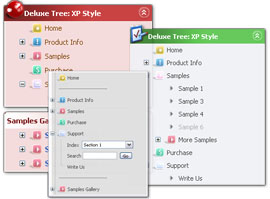
Menu Screenshots

Javascript Slidedown Menu Download Javascript

Features

Cost Effective
Compatibility              
  • Full cross-browser compatibility including IE, Netscape, Mozilla, Opera, Firefox, Konqueror and Safari on Windows, Mac OS and Linux
  • Menu can be populated from a database using ASP, PHP, etc.
  • Search engine friendly
  • Support for any doctypes
  • Fits for secure sites
  • Section 508 compliant
Html Frame Menu Javascript Slidedown Menu
Professional Look-n-feel
  • Entirely customizable look-n-feel
  • A lot of pre-designed javascript slidedown menu samples
  • Hundreds of visual effects
  • Custom CSS styles can be applied for all menu settings
Seamless Integration
  • Cross-frame support - menus work on frameset-based pages
  • Visible over flash, select boxes, iframes, java applets
  • Multiple menus on the same page
  • Amicable to other scripts and css styles
  • Any HTML code can be used inside menu items
High Performance
  • AJAX menu loading - loads web menu data from the server "on-the-fly".
  • Commonly loads quicker than other html page elements
  • UL/LI items structure
  • Runs well with an unlimited number of submenus and items


2.0 Buttons by Web-Buttons.com v3.0.0

Javascript Menu. DHTML Menu.

  • Submenus can be shown in 4 ways: - From from left to right + upwards and also left to right. - From right to left and also from right to left + upwards (e.g. for right-to-left languages).
  • Use images for icons, backgrounds of submenus and items. Using images you can create menus entirely based on graphics.
  • Create both horizontal and vertical menus and submenus with any amount of menus on one page.
  • Insert any HTML code inside the menu item - be it a form or a picture, a flash-object or a text. This ability allows you to create various menus of any complexity.

Recent Questions

Q: We bought a tab menu javascript licence yesterday and we can't figure out how to implement it into our web site.


A: See in Deluxe Tabs there are two modes:

1.   var tabMode=0;
You can create only one level of tabs and assign Object Id's of the
DIV's to show when you click on the tab.

["XP Tab 1","content1", "", "", "", "", "", "", "", ],
["XP Tab 2","content2", "", "", "", "", "", "", "", ],
["XP Tab 3","content3", "", "", "", "", "", "", "", ],
["XP Tab 4","content4", "", "", "", "", "", "", "", ],

You should paste your content in the <div> .. </div> tags.

<div id="content1" style=" visibility: hidden;" class="tabPage">
<p align=center><img src="img/logo_DM.gif" width=262 height=56 alt="Deluxe-Menu.com"></p>
</div>

<div id="content2" style="visibility: hidden;" class="tabPage">
<p align=center><img src="img/logo_DT.gif" width=262 height=56 alt="Deluxe-Tree.com"></p>
</div>

<div id="content3" style=" visibility: hidden;" class="tabPage">
<p align=center><img src="img/logo_DTabs.gif" width=254 height=58 alt="Deluxe-Tabs.com"></p>
</div>

2.   var tabMode=1;
You can assign only links in this mode.
You should create top level items with subitems.
["XP Tab 1","", "", "", "", "", "", "", "", ],
 ["|Link 1_1","http://deluxe-tabs.com", "", "", "", "", "0", "", "", ],
 ["|Link 1_2","testlink.htm", "", "", "", "", "0", "", "", ],
 ["|Link 1_3","testlink.htm", "", "", "", "", "0", "", "", ],
 ["|Link 1_4","testlink.htm", "", "", "", "", "0", "", "", ],
 ["|Link 1_5","testlink.htm", "", "", "", "", "0", "", "", ],
["XP Tab 2","", "", "", "", "", "", "", "", ],
 ["|Link 2_1","testlink.htm", "", "", "", "", "0", "", "", ],
 ["|Link 2_2","testlink.htm", "", "", "", "", "0", "", "", ],
 ["|Link 2_3","testlink.htm", "", "", "", "", "0", "", "", ],
 ["|Link 2_4","testlink.htm", "", "", "", "", "0", "", "", ],
 ["|Link 2_5","testlink.htm", "", "", "", "", "0", "", "", ],
["XP Tab 3","", "", "", "", "", "", "", "", ],  ["|Link 3_1","testlink.htm", "", "", "", "", "0", "", "", ],
 ["|Link 3_2","testlink.htm", "", "", "", "", "0", "", "", ],
 ["|Link 3_3","testlink.htm", "", "", "", "", "0", "", "", ],
 ["|Link 3_4","testlink.htm", "", "", "", "", "0", "", "", ],
 ["|Link 3_5","testlink.htm", "", "", "", "", "0", "", "", ],

You can use Object ID as well as Link in both modes. Use the following prefixes within item's link field:
"object:" - means that there is object id after it;
"link:" - means that there is a link after it.
"javascript:" - means that there is a javascript code after it, for
example:javascript:alert(\'Hello!\')
So, you should write for example:

 ["|Link 1_1","object:Content1_1", "", "", "", "", "0", "", "", ],


Q: I will build menu for several books’ Contents, each book is more than 100 lines and has links. I think if all the books’ contents in 1 *.JS file then it is TOO LOONG!!.
Can I break it down to 1 book for 1*.JS ? How?


A: You cannot divide your menuItems parameter.
You can only use one .js file for your menu parameters and the other.js file for your menuItems = [...];

But you can do it in two ways.

1) You can try to use several menus on the one page, for example:
param.js // file with menu parameters (all parameters before menuItems = [...];)
menu1.js // menuItems for "AC-DC", "ANLOG"
menu2.js // menuItems for "DIGITAL", "WinXP"
menu3.js // menuItems for "MS-Word", "MS-Excel"
In these menu files you should write
menuItems = [
...
];
dm_init();

Then you should install your menu in the following way

<script type="text/javascript" src="param.js"></script>
<table>
...
<script type="text/javascript" src="menu1.js"></script>
...
<script type="text/javascript" src="menu2.js"></script>
...
<script type="text/javascript" src="menu3.js"></script>

But it will be easier to use vertical menu in such case
  var isHorizontal=0;
  var smColumns=1;

2) You can also try to add some code, see the attached example.

In the first file (@MY books (Multiple Col.js) I write menuItems for the first item "AC-DC".
Notice that you should delete comma at the end of the last item
  var menuItems = [

["AC-DC","", , , , , , , , ],
 ["|@Book1","testlink.htm", , , , , , , , ],
...
 ["|@Book3","", , , , , , , , ],
   ["||CH02","", , , , , , , , ],
   ["||CH01","", , , , , , , , ] // delete comma at the end of the last item

];

In the second file (@MY books (1.js) you should write
menuItems = menuItems.concat(

[

["ANLOG","", , , , , , , , ],
 ["|@Book1","", , , , , , , , ],
 ["|@Book2","", , , , , , , , ],
 ["|@Book3","", , , , , , , , ] // delete comma at the end of the last item

]
);

In the third file (@MY books (2.js) you should write
menuItems = menuItems.concat(

[

["DIGITAL","", , , , , , , , ],
 ["|Item 1332","", , , , , , , , ],
["WinXP","", , , , , , , , ],
 ["|Item 1333","", , , , , , , , ],
["MS-Word","", , , , , , , , ],
 ["|Item 1334","", , , , , , , , ],
["MS-Excel","", , , , , , , , ],
 ["|Item 1335","", , , , , , , , ] // delete comma at the end of the last item
]
);

dm_init();

Notice that you should write dm_init(); function in the last file.

In the .html file you should write
...
<tr>
<script type="text/javascript" src="@MY books (Multiple Col.js"></script>
<script type="text/javascript" src="@MY books (1.js"></script>
<script type="text/javascript" src="@MY books (2.js"></script>
</tr>
I hope you understand me.


Q: I just purchased your Deluxe Menu maker. Wonderful tool!  

I have made a menu, uploaded it to my HTML folder at Typepad in the correct place and tried several OTHER places too.  

I have inserted the js snips into the head and body in all permutations of combinations.  

I checked it each time by both opening my site and viewing source.  

The menu is there. But it cannot be seen on the page. Never has been seen. Not even a hint of it being there.  

I tried .js .file   AND .js    AND CSS.  

No menu.  

I checked on four browsers.  

No menu.  

I verified the files are in my index place by copying them to notebook.  

I have done all of the above about 20 times EACH.

A: See, now you have:

<title>The Steel Deal - an oasis of reason in a sea of insanity.</title>

<!-- Deluxe Menu -->
<noscript><a href="http://deluxe-menu.com">Javascript Menu by Deluxe-Menu.com</a></noscript>
<script type="text/javascript">  var dmWorkPath = "/";</script>
<script type="text/javascript" src="dmenu.js"></script>
<!-- (c) 2007, by Deluxe-Menu.com -->


....

<meta name="verify-v1" content="VP25uY4F2NriQQhn7R3wK4aeYoMZpbafF+kkwx+vze4=" />
<!-- Deluxe Menu -->
<noscript><a href="http://deluxe-menu.com">Javascript Menu by Deluxe-Menu.com</a></noscript>
<script type="text/javascript">  var dmWorkPath = "/";</script>
<script type="text/javascript" src="/dmenu.js"></script>
<!-- (c) 2007, by Deluxe-Menu.com -->

</head>

It is not correct. You should call dmenu.js file only once.

Please, delete the second code.

There is now engine .js files

dmenu.js
dmenu4.js
dmenu_add.js
dmenu_dyn.js
dmenu_key.js
dmenu_cf.js
dmenu_popup.js
dmenu_ajax.js

and data file on your server.


Q: I recently purchased DeluxeMenu for a project I'm working on and a new requirement has been submitted.
I am looking for a way to dynamically affectthe contents of menu javascripts
after it's been rendered(displayed) in the browser.
Can this be accomplished with this component?

A: 1) You can use API functions to affect items dynamically:

http://deluxe-menu.com/functions-info.html

2) Generate your menu items dynamically from database.
Unfortunately we don't have working example with ASP.

You may generate a menu from a database or XML using any server-side script, e.g., PHP, ASP, VB, etc.
However, these scripts don't work inside of Javascript .js files, so,
you should move parameters of a menu from a .js file into an html-page, e.g.:

<!-- Deluxe Menu -->
<noscript><a href="http://deluxe-menu.com">Javascript Menu by Deluxe-Menu.com</a></noscript>
<script type="text/javascript">  var dmWorkPath = "menudir/";</script>
<script type="text/javascript" src="menudir/dmenu.js"></script>
<!-- (c) 2008, http://deluxe-menu.com -->

<script type="text/javascript" language="JavaScript1.2">
// and describe parameters of a menu
  var parameter1=value1;
  var parameter2=value2;
etc.

  var menuItems = [
// here you generate items using server-side scripts (php, asp, vb, etc.)
];
</script>>

The example of the menu working with PHP/MYSQL you can find here:
http://deluxe-menu.com/rq-loading-bar-MySQL-support.html