Recent Questions
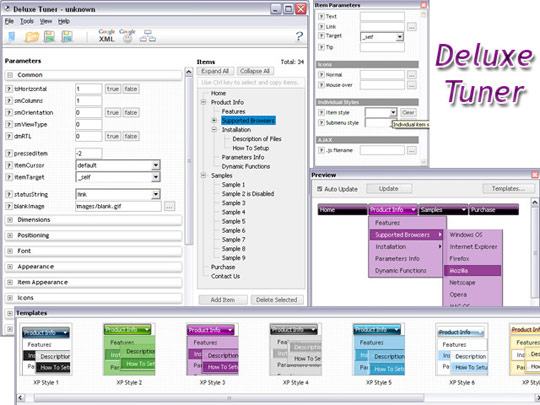
Q: I'm trying to find a decent, simple, working example of a dynamically-generated DHTML Pop-up Window. Using the "Deluxe Tuner" to generate static files is unacceptable for our use. We must create pop-up menus on the fly.
I tried piecing together a working pop-up window application, but kept getting "Error! Skin Load!" and couldn't figure out what files or where to get them (or put them) for the Windows Vista Graphite skin.
A: Create a new project, choose the Windows Vista Graphite Style for it.
Save your project. Use in your html file this function to open a window for your link :
onclick="deluxePopupWindow.open('window1', 'Content1', 'Window1','width=220,height=100,resizable,scrollbars=no,middle,right,fade-effect','windowsvista_graphite')";
See additional information about these functions here:
http://deluxepopupwindow.com/window-installation-info.html
Q: How can make dhtml tabs to open internet link in the same window?
A: You should set the following paramter in your data.js file (file, created in Deluxe Tuner),
where your tab-menu parameters (vars) and items ( var bmenuItems) are placed.
var bitemTarget = "_blank";
Default target for all items ("_self","_blank","_parent","_top",...).
If equal to "" - defined as "_self".
Or you can set target parameter in your data file using Deluxe Tuner:
"Tab mode" section in the menu parameters list.
Q: I make an example of html menu, but when i use it with frameset then the menu not show completly.
Is this possible, perhaps by using a javascript call?
A: To initialize the cross frame menu you should call dm_initFrame() function
instead of standard dm_init() function within data.js file:
dm_initFrame(framesetID, mainFrameInd, subFrameInd, orientation);
framesetID - id attribute of the frameset;
mainFrameInd - index of the main frame (where the top-menu is placed), >=0;
subFrameInd - index of the subframe (where the submenus will be shown), >=0;
orientation - frame orientaion: 0 - top-to-bottom, 1 - left-to-right; 2 - bottom-to-top; 3 - right-to-left.
You will find additioanal info about cross frame menu here:
http://deluxe-menu.com/cross-frame-mode-sample.htmlQ: I have one final question:-
If you go to http://domain.com/mainboard.asp
And click the tools icon.
My application has 3 types of settings.
Click the line icon (which highlights) then you can use the line tool Then click the thickness icon (which only changes the thickness of the line) And then click the colour icon (which only changes the colour of the line)
Unfortunately, when another icon is selected it resets the original icon.
Is there a way to show one of the top 8 function icons highlighted as well as the selected thickness icon and palette icon all in a selected state together?
A: function dm_ext_changeItem (menuInd, submenuInd, itemInd, iParams)
Changes parameters and an appearance of the item.
menuInd - index of a dropdown javascript menu on a page, >= 0.
submenuInd - index of a submenu, >= 0.
itemInd - index of an item, >=0. See more info about indexes here.
iParams = [array] - the array of item parameters. This parameter has the same structure as an item in menuItems array. You can assign parameters of another existent item of themenu or create new ones.
Structure of iParams:
[item_text, link, icon_normal, icon_over, tip, target, individual_style_index, jsFilename]
You should change icon_normal, icon_over parameters for the items.
http://deluxe-menu.com/functions-info.html