Sliding Menu Javascript by Deluxe-Menu.com
Sliding Menu Javascript

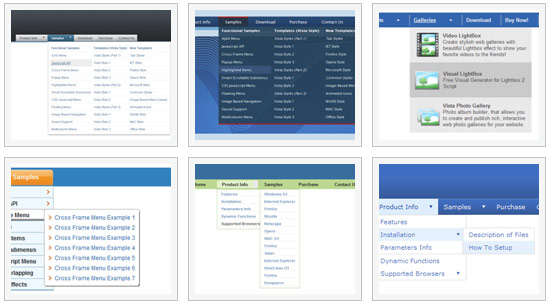
Menu Screenshots

Sliding Menu Javascript Dhtml Floating Menu Movable

Features

High Performance
  • AJAX menu loading - loads web menu data from the server "on-the-fly".
  • Commonly loads quicker than other html page elements
  • UL/LI items structure
  • Runs well with an unlimited number of submenus and items
Unrivalled Features
  • Scrollable, dragable, floating, right-click menus
  • Keyboard navigation - press Ctrl+F2 to enter the menu
  • Unique Java Script API for altering menu "on-the-fly", without page reloading
  • AJAX technology - loads menu data from the server "on-fly and on-demand".
  • Search feature - add the search area in the menu and type symbols. The found words will be higlighted.
  • Sound support!
Javascript Creating Pull Down Menus Sliding Menu Javascript
Cost Effective
Compatibility              
  • Full cross-browser compatibility including IE, Netscape, Mozilla, Opera, Firefox, Konqueror and Safari on Windows, Mac OS and Linux
  • Menu can be populated from a database using ASP, PHP, etc.
  • Search engine friendly
  • Support for any doctypes
  • Fits for secure sites
  • Section 508 compliant
Seamless Integration
  • Cross-frame support - menus work on frameset-based pages
  • Visible over flash, select boxes, iframes, java applets
  • Multiple menus on the same page
  • Amicable to other scripts and css styles
  • Any HTML code can be used inside menu items


2.0 Buttons by Web-Buttons.com v3.0.0

Javascript Menu. DHTML Menu.

  • Use images for backgrounds of submenus and items, icons, arrows. Using web images you can create menus completely based on graphics.
  • Design both horizontal and vertical menus and submenus with any amount of menus on a single page.
  • Place any HTML code inside the menu item - be it a flash-object, form, picture, or text. This ability lets you to build various menus of any complexity.
  • Submenus can be shown in 4 ways: - From left to right and also from left to right + upwards. - From right to left and also from right to left + upwards (e.g. for right-to-left languages).

Recent Questions

Q: I am trying to figure out how to specify the css for the top css dropdown menu.

I saw this in some of the example code, but there was nothing similar in Deluxe Tuner

  var itemStyles = [

["CSS=topItemNormal,topItemOver","CSSText=topItemTextNormal,topItemTextOver" ],
];
  var menuStyles = [
["CSS=topMenu"],
];

I tried adding the above to my js code, but it didn't work. I can get it to work in non-css through Deluxe Tuner.

I am trying to draw a white border around the blue css dropdown menu

.topMenu
{
background-color:Blue;
border-width: 1px;
border-style: solid;
border-color: White;
}

/* Style for submenus */
.submenu
{
}

/* Style for top items: normal state */
.topItemNormal
{
background-color:Blue;
color:White;
text-decoration: none;
text-transform:none;
font-weight:normal;
FONT-SIZE: 11pt;
FONT-FAMILY: Verdana, Arial;
width:100%;
padding:2px 4px;
}

A:   var itemStyles = [

["CSS=topItemNormal,topItemOver","CSSText=topItemTextNormal,topItemTextOver"],
];
  var menuStyles = [
["CSS=topMenu"],
];

The following code is Individual Styles. You can edit them in DeluxeTuner.

Open your data file, click "Edit Individual Styles..." button on themain window. And create individual item style and individual submenustyle. Then you should assign these styles to your items.

See more info about Individual Styles here:
http://deluxe-menu.com/individual-styles-sample.html


Q: How do I add content to each tab in the hover tab menu so that the content will appear on this same page
(as opposed to having to move to another page)?

A: You should paste your content in the <div> ..
tags.

<div id="content1" style=" visibility: hidden;" class="tabPage">
<p align=center><img src="img/logo_DM.gif" width=262 height=56 alt="Deluxe-Menu.com"></p>
</div>

<div id="content2" style="visibility: hidden;" class="tabPage">
<p align=center><img src="img/logo_DT.gif" width=262 height=56 alt="Deluxe-Tree.com"></p>
</div>

<div id="content3" style=" visibility: hidden;" class="tabPage">
<p align=center><img src="img/logo_DTabs.gif" width=254 height=58 alt="Deluxe-Tabs.com"></p>
</div>

See in Deluxe Tabs there are two modes:

1.   var tabMode=0;
You can create only one level of tabs and assign Object Id's of the
DIV's to show when you click on the tab.

["XP Tab 1","content1", "", "", "", "", "", "", "", ],
["XP Tab 2","content2", "", "", "", "", "", "", "", ],
["XP Tab 3","content3", "", "", "", "", "", "", "", ],
["XP Tab 4","content4", "", "", "", "", "", "", "", ],

2.   var tabMode=1;
You can assign only links in this mode.
You should create top level items with subitems.

["XP Tab 1","", "", "", "", "", "", "", "", ],
 ["|Link 1_1","http://deluxe-tabs.com", "", "", "", "", "0", "", "", ],
 ["|Link 1_2","testlink.htm", "", "", "", "", "0", "", "", ],
 ["|Link 1_3","testlink.htm", "", "", "", "", "0", "", "", ],
 ["|Link 1_4","testlink.htm", "", "", "", "", "0", "", "", ],
 ["|Link 1_5","testlink.htm", "", "", "", "", "0", "", "", ],
["XP Tab 2","", "", "", "", "", "", "", "", ],
 ["|Link 2_1","testlink.htm", "", "", "", "", "0", "", "", ],
 ["|Link 2_2","testlink.htm", "", "", "", "", "0", "", "", ],
 ["|Link 2_3","testlink.htm", "", "", "", "", "0", "", "", ],
 ["|Link 2_4","testlink.htm", "", "", "", "", "0", "", "", ],
 ["|Link 2_5","testlink.htm", "", "", "", "", "0", "", "", ],
["XP Tab 3","", "", "", "", "", "", "", "", ],
 ["|Link 3_1","testlink.htm", "", "", "", "", "0", "", "", ],
 ["|Link 3_2","testlink.htm", "", "", "", "", "0", "", "", ],
 ["|Link 3_3","testlink.htm", "", "", "", "", "0", "", "", ],
 ["|Link 3_4","testlink.htm", "", "", "", "", "0", "", "", ],
 ["|Link 3_5","testlink.htm", "", "", "", "", "0", "", "", ],

You can use Object ID as well as Link in both modes. Use the following prefixes within item's link field:
"object:" - means that there is object id after it;
"link:" - means that there is a link after it.
"javascript:" - means that there is a javascript code after it, for example:javascript:alert(\'Hello!\')

So, you should write for example:

 ["|Link 1_1","object:Content1_1", "", "", "", "", "0", "", "", ],


Q: Do you support keyboard shortcuts (up/down through javascript for drop down menu)? I couldn't find an example of that.

Also, this one from OpenCube (exploding submenus) runs on Firefox too. No way to get that in yours?

A: No, Deluxe Menu doesn't support transitional effect in Firefox. Thereis no way to do it in the current version of the menu. It is possiblethat we'll add this feature in the next versions.

Deluxe Menu has keyboard support. You can check it on our website
http://deluxe-menu.com/

Press Ctrl+F2 to enter/switch to next menu on the page.
Arrow keys - navigate
Esc - exit the menu

Use the following parameter to enable keystrokes support:
  var keystrokes = 1;
0 - disabled (default), 1 - enabled.

Use also the following parameters:
  var dm_focus = 1; Show focus selection for selected item.
  var dm_actKey = 113; Key code for keystrokes activation.
Works with Ctrl key only.
Default value is 113 = F2 key, 114 = F3 key, 115 = F4 key, etc.


Q: Is there a javascript API for the expandable menu tree to fire an user click event so the browser will load proper page accordingly? I looked around the current APIs from your site and could not find one.

Please advise.

A: You can use dtreet_ext_userClick (itemID) function.
See more info:

http://deluxe-tree.com/functions-info.html

Actually you can use your own Javascript code instead standard links and html code inside item text. For example:

  var tmenuItems = [
["text", "javascript:your_code_here"]
];

or

  var tmenuitems = [
["<div onClick='urlSubstitution(\'transco/sheet.asp?stype=1\')'>Table of Contents</div>", ""]
];