Recent Questions
Q: I would prefer to have a sort of documentation or tutorial video but asI have seen on you website there is not. I have also to mix the javascriptcode with php.
Could you please help me, software look fine but we don't have time totest the code, tutorial will be appricieted.
A: Unfortunately, we don't have tutorial yet, we'll try to create it inthe nearest future.
To create the pop up menu you should to do the following steps:
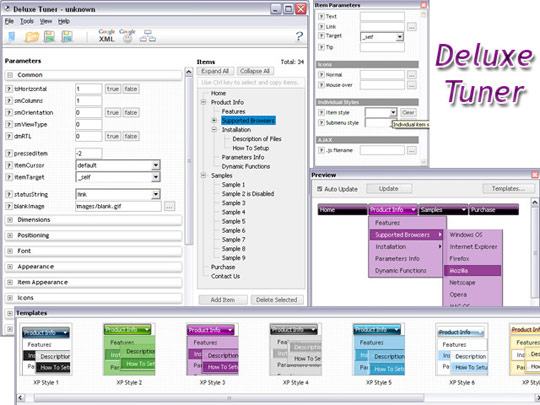
1. Create your menu in Deluxe Tuner application.
You can create any menu as you like in Deluxe Tuner.
Please, try to download trial package once again. We added alltemplates in Deluxe Tuner Templates window.
Unfortunately, Deluxe Tuner doesn't copy all need images forVista Template into your folder. You should do it manually.
After you create your menu in Deluxe Tuner you should copy all images youneed for the menu into your folder and correct images paths.
You should set the following parameter
var pathPrefix_img="";
2. You should add the following parameter for the pop up menu:
var popupMode=1;
You should do it manually. Please, open your data file in any texteditor and add such parameter.
3. You should install the menu on your page.
Add several rows into your html page.
<head>
...
<!-- Deluxe Menu -->
<noscript><a href="http://deluxe-menu.com">Javascript Menu by Deluxe-Menu.com</a></noscript>
<script type="text/javascript"> var dmWorkPath="deluxe-menu.files/";</script>
<script type="text/javascript" src="deluxe-menu.files/dmenu.js"></script>
<script type="text/javascript" src="data-deluxe-menu.js"></script> //data-deluxe-menu.js - data file created in Deluxe Tuner.
...
</head>
<body>
...
<img src="deluxe-menu.files/logo_w.gif" onClick="return dm_popup(0, 1000, event);">
...
</body>
Where return dm_popup(menuInd, pause, event, x, y)
menuInd - index of the menu on a page, >= 0.
pause - determines the time when the menu will be hidden.
event - constant. Do not change.
x, y - optional. Set these parameters if you want the menu to appear in the specified place. In other case the menu will be shown in the mouse position.
You should also copy all engine files
dmenu.js
dmenu4.js
dmenu_add.js
dmenu_dyn.js
dmenu_key.js
dmenu_cf.js
dmenu_popup.js
dmenu_ajax.js
into "deluxe-menu.files/" folder. You should place this folder in thesame folder with your index. html page.
Try that.
Q: I'd like to purchase your deluxe menu, but for the life of me I cannot figure out how to align the javascript sub menu to the top of the primary menu in Firefox. It aligns correctly in IE but in Firefox it is dropping by 20 pixels or so below where I want it.
A: This is space to document borders. We've set this space, so that yourjavascript sub menu will not look like the part of browser window. If you wantyou can delete that space.
Open dmenu.js file in any text editor and find the following code:
space=15;
Change 15 to 0.
space=0;
Q: Can I request something for your next version please.....individual javascript list menu border colours, I think it would then be possible to create a dropped shadow effect perhaps :)
A: You can use different colors for each border side now.
For example:
var menuBorderColor="#C0AF62 #4949E0 #000000 #B31E1E";top right bottom left
Q: I have been trying for months to find an answer to my submenu problem using your FAQ and Recent Questions.
The only thing that comes close to an answer is from one of your Recent Questions below, but I don't understand the answer. Will you please give me specific code or info to fix? Please refer to my frameset code and data.js info, which I've provided further down this message.
I am using cross frame menu dropdown. I have three frames: Top, Left and main (middle).
I am using the script and data from your sample file, it works fine. Only problem is submenu is offset to the right. It does not show up exactly down below the top javascript hide menu.
A: Yes, I suppose that the reason is in your frame structure. For examplenow you have:
top -------------------
**MENU**
left--|main------------
|
| **submenus**
|
Try to add additional frame in your top frame with the same width asyour left frame has:
l-top-|right-top-----------------
| **MENU**
left--|main----------------------
|
| **submenus**
|
 Features