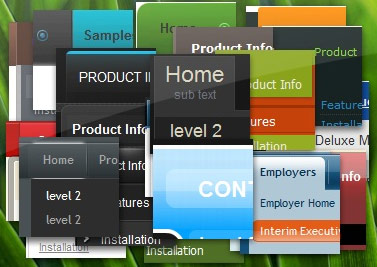
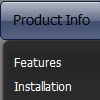
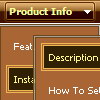
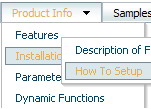
- AJAX menu loading - loads web menu data from the server "on-the-fly". - Items with icons - Sound support! - Inactive/Disabled items - Special JavaScript API for changing javascript menu "on-the-fly" - Submenus automatically scrolls - Cross-frame support - menus work on frameset-based pages - Search feature - add the search area in the menu and type symbols.
Sub menus dropdown over all the objects on the page (select, applet, flash, object, embed). If for some reasons (old browser) a submenu can't go over an object, the object will be hidden for a time when the submenu is shown.
Design personal styles for any submenu and item. Use individual styles to rich killer visual effects!
These effects will make your menu neat and chic. You can set transparency, cast a shadow on the menu and submenus. Among available special visual effects there are random dissolve, fade, mix, mosaic slide out and many many others.
Q: I am using Javascript Menu. Deluxe Menu. v1.12 How can I upgrade to v.2.0?
A:How to upgrade to v2.00 --------------------------------------------------------------- You can download the licensed engine .js files from the same link in your license message.Deluxe Menu v2.00 has new parameters and features. To upgrade to v2.00 you should do the following.
Step 1. 1.1 For Windows users a. Run Deluxe Tuner v2.0 (can be found in the trial menu package v2.0 http://deluxe-menu.com/deluxe-menu.zip). b. Open menu data file (.js file where menu parameters are placed): select File/OpenЕ c. Save the file: select File/Save, then click "No" button when the dialog box appears.
1.2 For other OS users a. Open menu data file (.js file where menu parameters are placed) in a text editor. b. Make sure that the following variables exist in the data file:
var keystrokes = 0; var dm_focus = 1; var dm_actKey = 113;
var dynamic = 0; var smHideOnClick = 1; var itemAlignTop = 'left'; var smSmartScroll = 1;
var dmAJAX = 0; var dmAJAXCount = 30; var dmRTL = 0; var dmObjectsCheck = 0; var menuBackRepeat = "repeat"; var menuHeight = ""; var transDuration2 = 200;
If one of the variables doesn't exist - add it at the beginning of the file.
c. Save the file.
Step 2. Now open HTML-page that contains Deluxe Menu.
Step 3. Replace existent tags of the menu by the following code:
<noscript><a href="http://deluxe-menu.com">Javascript Menu by Deluxe-Menu.com</a></noscript>
Step 4. Save HTML-page.
Step 5. New engine v2.00 has 7 .js files. They are: - dmenu.js - dmenu4.js - dmenu_add.js - dmenu_dyn.js - dmenu_key.js - dmenu_cf.js (new v2.00) - dmenu_popup.js (new v2.00)
Replace all old .js files by the files from v2.00.
Try that.
Q: In deluxe tuner, horizontal dhtml menu, how I make sure long menu items can wrap into 2 lines?
A:You should set the following parameter:
var noWrap=0;
Or use standard tags inside item's text:
["International Music X Home Decoration X Books","", "", "", "", "", "0", "0", "", "", "", ],
Q: How do I turn off transitional effects in my ajax dropdown menu?
A:You should set the following ajax dropdown menu parameters.
var transition=-1; var transOptions=""; var transDuration=0; var transDuration2=0;
Q: I just purchased your product and I have it installed and it is working great. Great job with this product.
I am wondering why I am only seeing just a small percentage of the templates for the css rollover menus. On your web page, there seem to be dozens of different styles to choose from. On my local software there is only a few. Can I download the additional "vista" styles somehow?
A:We've included all templates in the installation package.
You can also find all templates in the following folder: C:\Program Files\Deluxe Menus\deluxe-menu\Templates\
pueden hacer clic derecho sobre el icono y cambiar el nombre por "e", ..... Nos Vamos a la Barra de Menu - Menu Bar en el Editor de Windows que se llama Regedit y ..... y todo aquellos archivos JS que son de Java Script para que funcionen las .... Hacemos clic en el icono. Conexiones de red. En la ventana emergente
Por favor, haga doble clic en el archivo descargado. .... vulnerabilidades: debes actualizar esos programas que salen: winzip, flash, java, etc. ... -Estan bloqueado las ventanas emergentes y me salen cuando estoy viendo una paguina web . ... Saldrá un menú para elegir el arranque elige modo seguro
Sun, Sun Microsystems, le logo Sun, le logo Solaris, le logo Java Coffee Cup, docs.sun.com, NetBeans, ...... OpenSolaris, el menú GRUB ofrece la opción de arrancar el ..... Haga clic con el botón derecho del ratón para anular la ampliación. .... En la ventana emergente, elija una ubicación para el software
Con el ratón, hacer clic derecho (botón derecho del ratón) en la carpeta. ... C y D t,tambien aparece en el menu de inicio/todos los programas/inicio ... C:\ Archivos de programa\Java\jre1.6.0_03\bin\jusched.exe ..... de ventanas emergentes - {EF99BD32-C1FB-11D2-892F-0090271D4F88} - (no file)
Sun, Sun Microsystems, le logo Sun, le logo Solaris, le logo Java Coffee Cup, docs.sun.com, NetBeans, ...... OpenSolaris, el menú GRUB ofrece la opción de arrancar el ..... Haga clic con el botón derecho del ratón para anular la ampliación. .... En la ventana emergente, elija una ubicación para el software
Pontiac's War . Unit and Model added for J. Campbell .... Más detalles en una ventana emergente que aparece durante el juego. ..... Para renombrar hacer clic derecho sobre la pestaña de la fuerza con la tecla Alt Gr presionada. .... del menú de inicio de windows junto al resto de accesos del WIA
Al detectar una nueva versión de eMule: Una ventana emergente se .... Acción: Si pulsamos en esta lista con el botón derecho del ratón después de ... acciones que se verán en el menú contextual de esa lista. ... Activar MobileMule: Permite acceder a eMule via teléfono móvil compatible con java
R3 - URLSearchHook: Barra Yahoo! con bloqueador de ventanas emergentes .... O8 - Extra context menu item: E&xportar a Microsoft Excel .... BHO (ejemplos de esto son el java, el acrobat reader, etc) ... en privado (si haces clic en "mi perfil "," bandeja de entrada", alli puedes encontrar los que has recibido)
también se indica cómo acceder a ella desde el menú del navegador. ... privada en un solo cuadro (Ver Tablas Resumen:”Borrar info con 1 click”), ..... Herramientas>Descargas>(seleccionar y botón derecho del ratón)>Eliminar descarga .... emergentes. Lista blanca/negra. Administración. Administración de. Java/