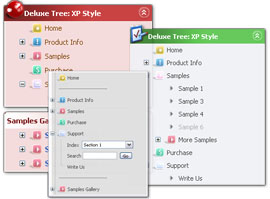
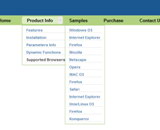
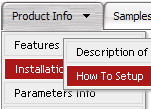
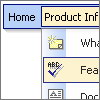
- Several menus on one page - Items with icons - 85% transparency for sub menus - Top items and submenus have a shadow - Transition #14 - "fade out" effect - Text aligned to left - Sound support! - Special JavaScript API for changing javascript menu "on-the-fly"
Good navigation system is an important part of web site success. If people can't find their way around the site, they will rapidly give up looking and go, never to return. So, it's very significant that your website has a neat, fast, and gratifying to the eye navigation. Don't permit your web site visitors to get lost. Try Deluxe Menu!
Q: We are facing a problem with display of deluxe menu in Internet explorer 7.0 Java script menuis displaying fine in Mozilla Firefox & Internet Exploer 6.0.
A:Your browser has JavaScript option disabled. It means that no one JavaScript element can be run. You should to enable JavaScript in IE:
Tools -> Internet Options -> Security -> Custom level... -> Scripting -> Active Scripting = Enable
There is no way to enable these preferences automatically, in othercase there are no reasons to create security preferences.
You can use search engine friendly code, so you'll see all yourlinks (for the main items and submenus) when your security settings in IE doesn't allow Javascript.
You can generate search engine friendly code. Deluxe Menu is a search engine friendly menu since v1.12. To create a search engine friendly menu you should add additional html code within your html page:
To generate such a code use Deluxe Tuner application. You can find this GUI in the trial package. Run Tuner, load your menu and click Tools/Generate SE-friendly Code (F3).
Q: How do I get the sub-menus to open in the 2nd frame of a 3 vertical frameset.
The menu is in the first frame. I want the sub-menus to open in the 2nd frame. I don't see how to set that parameter.
framesetID - id attribute of the frameset; mainFrameInd - index of the main frame (where the top-menu is placed), >=0; subFrameInd - index of the subframe (where the submenus will be shown), >=0; orientation - frame orientaion: 0 - horizontal, 1 - vertical.
You should write it, for example dm_initFrame("frmSet", 0, 1, 0);
Q: How can I upgrade to Deluxe Menu v2.0? Now I'm using v1.14.
A: How to upgrade to v2.00 --------------------------------------------------------------- You can download the licensed engine .js files from the same link in your license message. Deluxe Menu v2.00 has new parameters and features. To upgrade to v2.00 you should do the following.
Step 1. 1.1 For Windows users a. Run Deluxe Tuner v2.0 (can be found in the trial menu package v2.0 http://deluxe-menu.com/deluxe-menu.zip). b. Open menu data file (.js file where menu parameters are placed): select File/Open… c. Save the file: select File/Save, then click "No" button when the dialog box appears.
1.2 For other OS users a. Open menu data file (.js file where menu parameters are placed) in a text editor. b. Make sure that the following variables exist in the data file:
var keystrokes = 0; var dm_focus = 1; var dm_actKey = 113;
var dynamic = 0; var smHideOnClick = 1; var itemAlignTop = 'left'; var smSmartScroll = 1;
var dmAJAX = 0; var dmAJAXCount = 30; var dmRTL = 0; var dmObjectsCheck = 0; var menuBackRepeat = "repeat"; var menuHeight = ""; var transDuration2 = 200;
If one of the variables doesn't exist - add it at the beginning of the file.
c. Save the file.
Step 2. Now open HTML-page that contains Deluxe Menu.
Step 3. Replace existent tags of the menu by the following code:
Step 4. Save HTML-page.
Step 5. New engine v2.00 has 7 .js files. They are: - dmenu.js - dmenu4.js - dmenu_add.js - dmenu_dyn.js - dmenu_key.js - dmenu_cf.js (new v2.00) - dmenu_popup.js (new v2.00)
Replace all old .js files by the files from v2.00.
Try that.
Q: I need to set individual itemtargets for a number of menu script items......
example:-
var itemTarget="Main";
menuitem_1 targets the Main frame..
menuitem_2 ..
SUBmenuitem_2_(1) targets the Top frame..
SUBmenuitem_2_(2) targets the Main frame..
menuitem_3 ..
SUBmenuitem_3_(1) targets the Main frame..
SUBmenuitem_3_(2) targets the Bottom frame..
menuitem_4 targets the Main frame..
Is this possible?
A:You can set target parameter for all items: var itemTarget="_blank"; or var itemTarget="main";
Where main - is the name of the main frame where you want to open the link.
or for each item individually: ["Home","testlink.html", "", "", "", "_blank", "", "", "", "", "", ], ... ["Home","testlink.html", "", "", "", "main", "", "", "", "", "", ],
23 Sep 2009 ... Ahora haz click en el icono del pincel, debajo en el menú que ... Ahora, en la ventana de capas, en la lista desplegable de "Modo", selecciona "Multiplicar". ... Establece el radio de desenfoque en 18 (vertical y horizontal). ... pero también podrías probar algún efecto diferente seleccionando el
x y no se como hacer para que el top menu despliegue sub menues, ... tengo el main menu vertical que despliega submenues sin problemas y el top menu ... Realmente no se como modificarlo para lograr el efecto de submenus
... como por ejemplo saber encontrar todos los menús y opciones, ... Los tipos de terreno se hallan descritos en el desplegable adjunto al juego. ..... Los muebles de lujo, situados en la cúspide de la cadena vertical de producción, ..... Estas políticas tienen efecto en la felicidad de los POPs
y seleccionaremos el formato adecuado de la lista desplegable. .... con este tipo de vista podemos apreciar los efectos animados que hayamos podido insertar en las ..... un espejo puesto de forma vertical frente al objeto original)
Este ha quedado dividido, a efectos de los emuladores, ..... Yo lo tengo así: 640x480, 32, default hz, line mode = double, Vertical y horizontal centering activado. .... en el menú desplegable donde pone SPTi, ASPI, etc
Nos situamos sobre la capa que acabamos de crear, (Efecto 1) y le ... A continuación sacamos una línea vertical y otra horizontal de las reglas, .... Haz clic derecho con el mouse para obtener el menú desplegable
Ahí debajo hay un menú desplegable en el cual figuran todas las entidades que no ... hacer lo mismo con la cara contraria y lograremos el mismo efecto. ... El tipo de escaleras que vamos a diseñar son las verticales,
vspace = margen Indica el número de puntos verticales que separaran la imagen .... Si se indica 1 se presenta como un menú desplegable, se se indica mas de uno se .... consiguiendo un efecto muy elegante, siempre y cuando el "fondo" de
18 Feb 2010 ... Frecuencia vertical 56 - 77 Hz Maximum Pixel Clock 80 MHz. Resolución máxima 1024 x 768 ... Animación de cuadros al abrir un menú desplegable Activado/a. Efecto de sombra ... Efecto de desvanecimiento del menú Activado/a
Menú del foro .... Y luego, el coste de instalar el mástil desplegable con la cometa y .... con el famoso efecto "Hadley Cell circulation" que es tan original , ..... sino utilizando generadores eólicos de eje vertical
Barra de herramientas adicional en ventana de transferencias: Aparecerán nuevos .... nuevos separándolos por el carácter | (barra vertical o pipeline). ..... Esto conlleva timeouts y otros efectos no deseados en eMule
Fundación HETAH. Open in new window. Menú Principal ...... evita la necesidad de circulación vertical entre los cuatro niveles proyectados. ..... adelante y vio que al ser aplicadas al ser humano tenían el mismo efecto,