Recent Questions
Q: A couple days ago I purchased the multi-website license of Deluxe Menu/Tree/Tabs/Popup Window/Calendar for US$149.00
I am having a very hard time getting the popup window to do just a basic function.
All I want is to have a link that I click on the page and the dhtml menu windows pop up.
As it is, the page automatically opens the popup window on loading.
I'm not a Javascript programmer which is why I purchased your product as it seemed I could pick a couple basic values in the GUI and it would create the script and code for me.
It would be REALLY handy if you had a couple of examples of how to create the following:
- Open the popup window upon the page loading
- Open the popup window when the user clicks a link
- Open the popup window when the user mouses over a link
- Close the popup window when the user mouses out
The help section doesn't even provide a menu item for the popup window.
Finding support for it on your site is difficult and what I can find is better suited for someone with Javascript knowledge.
Is there any way you can provide me the code to do this?
Thanks very much for your time and assistance.
A: We have such example on our website:
> - Open the popup dhtml menu windows upon the page loading
To open the popup window upon the page loading you should set thefollowing parameter:
openAfter=0
deluxePopupWindow.attachToEvent(win,'openAfter=0,,,,,')
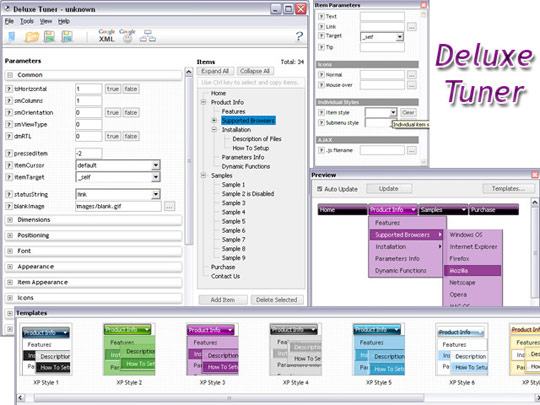
You can find this parameter in Deluxe Tuner. See on-load.zip example.
> - Open the popup window when the user clicks a link
Create the popup window in Deluxe Tuner and save it as html. UseonClick event for a link.
See how you should write your link:
<a class="sampleLink" title="Click to open sample" href="javascript:;" onclick="deluxePopupWindow.open('win', '<DIV style=\'PADDING-RIGHT: 10px; PADDING-LEFT: 10px; PADDING-BOTTOM: 10px; COLOR: #d33a3a; PADDING-TOP: 10px; TEXT-ALIGN: center\'><B>Sample content</B></DIV><DIV style=\'font: 13px;text-align: center; color:#666666; \'><EM>This is a simple HTML code for content. Here you may also set link to content page or ID of some element.</EM>', 'Safari Style', 'width=250,height=100,resizable,scrollbars,minimizable,fullscreen,middle,right,fade-effect,opacity=1,floatable=yes', 'windows_safari')"><b>this link</b></a> opens a medium-sized dhtml floating window.
where (see on-click.js file)
'win' - is winID
'<DIV style=\'PADDING-RIGHT: 10px; PADDING-LEFT: 10px; PADDING-BOTTOM:
10px; COLOR: #d33a3a; PADDING-TOP: 10px; TEXT-ALIGN:center\'>
<B>Sample content</B></DIV><DIV style=\'font:
13px;text-align: center; color:#666666; \'><EM>This is a
simple HTML code for content. Here you may also set link to
content page or ID of some element.</EM>' - content of your
popup window
'Safari Style' - window title
'width=250,height=100,resizable,scrollbars,minimizable,fullscreen,middle,right,fade-effect,opacity=1,floatable=yes' - parameters of the popup window'windows_safari' - window skin
You can find more info about deluxePopupWindow.open function here:
http://deluxepopupwindow.com/window-installation-info.html
Notice that you shouldn't set openAfter parameter in on-click.jsfile:
deluxePopupWindow.attachToEvent(win,',,,,,')
> - Open the popup window when the user mouses over a link
> - Close the popup window when the user mouses out
You should create such popup in the same way as in the previous point,but use onMouseOver/onMouseOut events.
<a class="sampleLink" title="Click to open sample" href="javascript:;" onMouseOver="deluxePopupWindow.open('win', '<DIV style=\'PADDING-RIGHT: 10px; PADDING-LEFT: 10px; PADDING-BOTTOM: 10px; COLOR: #d33a3a; PADDING-TOP: 10px; TEXT-ALIGN: center\'><B>Sample content</B></DIV><DIV style=\'font: 13px;text-align: center; color:#666666; \'><EM>This is a simple HTML code for content. Here you may also set link to content page or ID of some element.</EM>', 'Safari Style', 'width=250,height=100,resizable,scrollbars,minimizable,fullscreen,middle,right,fade-effect,opacity=1,floatable=yes', 'windows_safari')"><b>this link</b></a> opens a medium-sized dhtml floating window.
<a class="sampleLink" title="Click to open sample" href="javascript:;" onMouseOut="deluxePopupWindow.open('win', '<DIV style=\'PADDING-RIGHT: 10px; PADDING-LEFT: 10px; PADDING-BOTTOM: 10px; COLOR: #d33a3a; PADDING-TOP: 10px; TEXT-ALIGN: center\'><B>Sample content</B></DIV><DIV style=\'font: 13px;text-align: center; color:#666666; \'><EM>This is a simple HTML code for content. Here you may also set link to content page or ID of some element.</EM>', 'Safari Style', 'width=250,height=100,resizable,scrollbars,minimizable,fullscreen,bottom,left,fade-effect,opacity=1,floatable=yes', 'windows_safari')"><b>Open popup window</b></a>
Q: My submenu in the mouse over drop down menu is faded too quickly if I pull away the mouse.
A: Try to use the following parameter:
You can use the following parameters there:
var smShowPause=200;
var smHidePause=5000;
Q: I want to have the dhtml popup display as you mouse over an image - is this possible?
A: For example you want to open a popup onMouseover, onClick oronMouseout on a link.
So, you should create a link on your page and set id="" for it, forexample:
<a href="javascript:;" id="link">Open popup OnClick</a>
<a href="javascript:;" id="over">Open popup OnMouseover</a>
<a href="javascript:;" id="out">Open popup OnMouseOut</a>
In Deluxe Tuner you should set:
onMouseOver - over
onMouseOut - out
onClick - link
So you'll have
deluxePopupWindow.attachToEvent(win,',,onClick=link,onMouseOver=over,onMouseOut=out,')Q: I have downloaded the trial version of Deluxe Menu and am seriously looking at buyingit. I am trying to go thro the instructions and check out if it meets my requirement.
I am not able to figure out how to equally space out all my menu items on the javascript menu bar.
My menu bar width is fixed at 800 px and I have 7 items - horizontal type. The menuitems widths appear different for the menu items. How do I ensure that all of them are ofequal size ??
A: Set width for the items using Individual styles:
var itemStyles=[
["itemWidth=100px"],
] //style 0
Assign Individual Styles for the menu Items.
var menuItems = [
["Item 1","", "", "", "", "", "0", "", "", "", "", ], //style 0
["Item 2",", "data2.files/icon1.gif", "data2.files/icon1o.gif", "", "", "0", "", "", "", "", ], //style 0
];