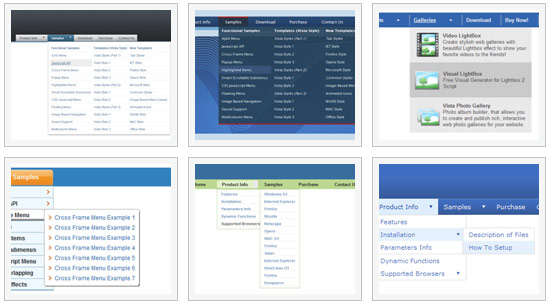
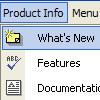
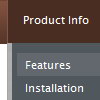
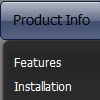
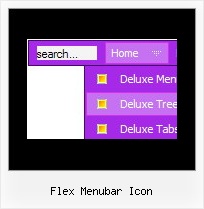
- Deluxe Tuner - visual interface to create and modify dhtml menus easily and in no time. - Top items and submenus have a shadow - Text aligned to left - Items with icons - Relative/Absolute menu position - Keyboard navigation - press Ctrl+F2 to enter the top menu - Transition #14 - "fade out" effect - Special JavaScript API for changing javascript menu "on-the-fly"
Apply any font of any color, size and font decoration you need. Use any available type, color and thickness of a menu's frame. Choose any color for submenus and items backgrounds.
Set the size of the menu in percent, pixels, or other units. This menu may have a relative (it can be inserted into the table, for example) or absolute position .
Specify various values for spacing and padding for the whole menu and for each separate submenu.
You can specify a time for delays in showing or hiding of a submenu. Use special prefixes for image paths and links to make paths absolute.
Create separators using your own pictures, size and alignment.
Q: How can I upgrade to Deluxe Menu v2.0? Now I'm using v1.14.
A: How to upgrade to v2.00 --------------------------------------------------------------- You can download the licensed engine .js files from the same link in your license message. Deluxe Menu v2.00 has new parameters and features. To upgrade to v2.00 you should do the following.
Step 1. 1.1 For Windows users a. Run Deluxe Tuner v2.0 (can be found in the trial menu package v2.0 http://deluxe-menu.com/deluxe-menu.zip). b. Open menu data file (.js file where menu parameters are placed): select File/Open… c. Save the file: select File/Save, then click "No" button when the dialog box appears.
1.2 For other OS users a. Open menu data file (.js file where menu parameters are placed) in a text editor. b. Make sure that the following variables exist in the data file:
var keystrokes = 0; var dm_focus = 1; var dm_actKey = 113;
var dynamic = 0; var smHideOnClick = 1; var itemAlignTop = 'left'; var smSmartScroll = 1;
var dmAJAX = 0; var dmAJAXCount = 30; var dmRTL = 0; var dmObjectsCheck = 0; var menuBackRepeat = "repeat"; var menuHeight = ""; var transDuration2 = 200;
If one of the variables doesn't exist - add it at the beginning of the file.
c. Save the file.
Step 2. Now open HTML-page that contains Deluxe Menu.
Step 3. Replace existent tags of the menu by the following code:
Step 4. Save HTML-page.
Step 5. New engine v2.00 has 7 .js files. They are: - dmenu.js - dmenu4.js - dmenu_add.js - dmenu_dyn.js - dmenu_key.js - dmenu_cf.js (new v2.00) - dmenu_popup.js (new v2.00)
Replace all old .js files by the files from v2.00.
Try that.
Q: Cross-frame mode/ showByClick=1: I only want this to work on the main level javascript menu bar, not the submenus. Is there anyway to showbyclick only for the main level and then not for the submenus?
A: You can use Individual Item Styles to set showByClick parameter forthe top items only.
var itemStyles = [ ["showByClick=1"], ];
Q: Is there a way to have the sub menus open to the left instead of the right?
A: You should set the following parameter:
var smViewType=2;
Q: How can I have two menus dhtml under each other using the float option? So that do not collide with each other?
A: You can try to adjust the following parameters to the one menu:
Flexforum.de > Flex > Programmieren mit Flex .... ActionScript in DataGridColumn : Icon anzeigen wenn Text vorhanden · einzelne Zeile einer TextArea auslesen
-moz-box-flex: 0 !important; } #urlbar-container { ... Wie kann ich ein Symbol nicht über einen Link sondern codiert in eine CSS einbinden? ... Benutzung von CompactMenu ausgelegt, deshalb ist die Menubar nicht schön:
Import Excel Data into MS Access · How to add Column Headers in MS flex grid ... How get value to variable through modem using phone line · icons in menubar
Icones pour chaque dossier de marque-pages dans la barre personnelle */ .... - moz-box-flex: 400 !important; } /* Largeur de la boite de recherche */ ... menubar > menu, menupopup > menu, popup > menu, menuitem, toolbarbutton
... Control Panel · Add/Remove Programs · saving images to database · Icon on Menu (with menu editor) ... Dynamic Menubar at runtime · has anybody ever programmed ie with vb? ... dynaset error · MS Flex Grid and Properties Window
Tu dois avoir langDisable dans la DS de ton Flex. .... <icon>link_popup.gif</ icon> <script>browse_links.php?mode=wizard</script> <JSopenParams>height=300, width=500,status=0,menubar=0,scrollbars=1</JSopenParams>
... Can Applet compete with RIA client, such as Flex and GWT? ...... displaying applets without the titlebar,menubar and status bar · file deleting problem
Flexforum.de > Flex > Programmieren mit Flex ... dynamisches erstellen von Panel geht nicht · Problem mit Panel für Funktion und MenuBar für Zinc und SW HX!
Show Image icon infront of http URL ? need help with dynamic table ..... Passing correct image-file path in jsp to an embedded adobe flex component ..... Form1 has no properties error · Menubar using JavaScript · Modal versus Modless IE
Flex FX Mac Flexify FlexoStepX for Illustrator Flickr iPhoto Plugin .... IP in menubar IPMenu IPNetMonitorX IPNetRouterX IPNetSentryX IPNetShareX Pro IPNetTunerX .... LuaLua Mac OS X Desktop Icons - For Dog Lovers Luck of the Draw
Archiv verlassen und diese Seite im Standarddesign anzeigen : Flex programmieren ... Font-Resizer für Appplikation · ftp lib von maliboo · Bitmap als Button.icon ? .... MenuBar - Klick auf Knoten · Webserviceabfrage ausgeben
falseUpIcon - The icon up state. The default value is undefined. ... NOTE:::: You may notice that if you are also using a MenuBar component etc in the ..... SilverLight, Flash Catalyst, Flash Builder (Flex), AIR, Flash CS3 / Flash 9
[Архив] Страница 10 Вопросы по Flash/Flex Builder, MXML, Flex 2-4 Framework и Flex Data ... доступ к реестру · MenuBar - ошибка при обработке выбора пункта меню ... Что стандартный отрисовщик TileList хочет увидеть в качестве icon?